
Root-zone observations
Calibrate moisture readings against a reference method for the actual soil. Record probe depth, location and calibration version. One shallow sensor does not measure an entire root profile.
Apollo AgriVerse / SIH / Hardware development
The hardware behind an explainable field.
This hardware work is being developed under Apollo's NavaKrishi team, the D Y Patil SIH team working within Apollo AgriVerse. Its focus is the sensing and integration layer that connects field observations to Intelligent Soil decision support.
Part of Apollo Continuum's wider research ecosystem.
D Y Patil SIH hardware and Intelligent Soil work package.
Physical assembly, sensor calibration and field validation require recorded tests.
System architecture
The field node measures. The base station checks, stores and interprets. The farmer decides. The following is the proposed integration workflow, not a claim of commissioned field hardware.
A qualified soil-moisture probe and temperature channel connect to an ESP32-class controller. Keep raw readings, device identity, units and observation time.
A selected wired or radio bridge delivers buffered events to the station. LoRa transport and MQTT messaging are separate layers; interface selection remains subject to review.
Validate schema, units, age and sequence. Preserve original events; derive calibrated records separately. Deduplicate retries and expose sensor faults.
Combine usable observations with crop, soil and irrigation context. Compare scenarios, explain uncertainty and recommend irrigate, delay, partial cycle or inspect.
Human-controlled advisory scope: no automatic mains-pump operation. Missing readings are not zero, and simulated inputs must never be presented as measured field telemetry.
Inside the reference assembly
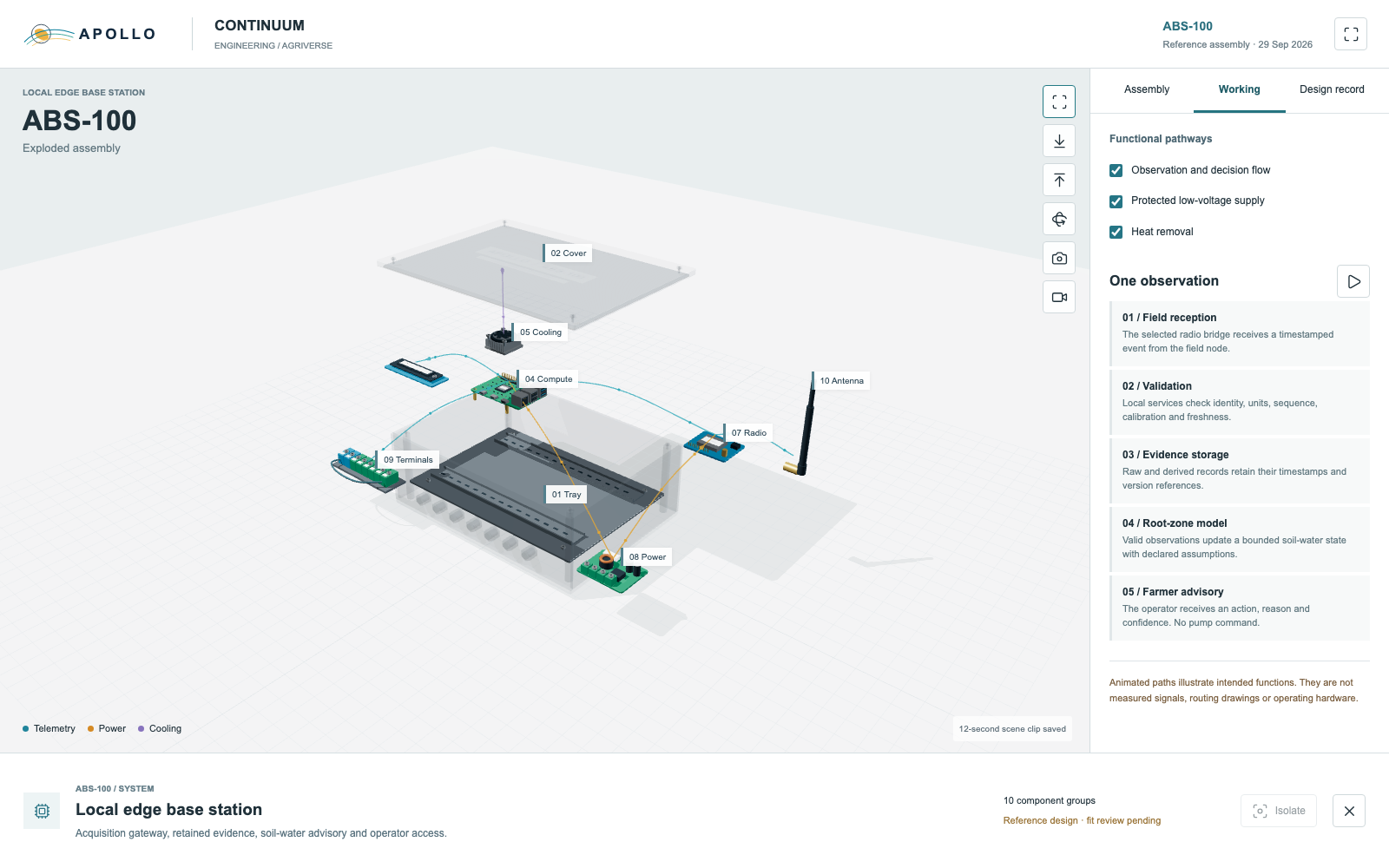
The ABS-100 reference uses a Raspberry Pi 5-class computer, an 8 GB reference configuration, durable storage and protected power. Exact part numbers, connectors and ratings must be frozen before procurement or fabrication.
Compute board: runs ingestion, local services and advisory calculations. NVMe storage: retains observations and model records. Real-time clock: supports time continuity; clock uncertainty must still be recorded when synchronization is unavailable.
The bridge connects selected field-node transport to the local station. Sensor terminals provide serviceable interface connections. Confirm voltage levels, isolation requirements, connector pinouts and cable routing against the chosen devices; this illustration is not a wiring schematic.
A reviewed 5 V power path, supervised shutdown and heat sink or cooler support reliable operation. Measure load, startup behaviour and temperatures on the bench before selecting the final supply and enclosure arrangement.
The tray, mounting plate and removable cover organize the assembly and allow maintenance. Check clearances, fastening, strain relief and environmental protection with actual parts. No ingress-protection rating is claimed for the reference visualization.
The antenna belongs to the selected radio system. Review radio compliance, range and positioning before field use. Ethernet maintenance and an approved local Wi-Fi option provide service access without making cloud connectivity a prerequisite for the intended local advisory loop.
Intelligent Soil integration
Calibrate moisture readings against a reference method for the actual soil. Record probe depth, location and calibration version. One shallow sensor does not measure an entire root profile.
Compare treatments under matched inputs. Hydrogel is a finite water store, not a water source. Record water added, retained, released and drained. Keep reusable sensor electronics separate from replaceable mulch materials.
The Intelligent Soil MVP explores scenarios. Apollo Anchor is a separate base-station software pilot. Neither interface alone demonstrates a physical device connection or proves agronomic performance.
Build and verification
These are acceptance gates, not completed milestones. Each requires a dated record, test conditions and an accountable reviewer.
Confirm sensor, controller, transport, sampling cadence, stale-data thresholds, power budget and parts list. Review the enclosure against real dimensions.
Capture raw and calibrated readings. Test disconnects, invalid packets, duplicate replay and restart recovery before adding further nodes.
Compare control and amendment treatments with measured inputs and balance residuals. Preserve unsuccessful trials and record uncertainty.
Document installation, maintenance, local recovery and operator training. Compare predictions with timestamped measurements before making performance claims.
Engineering records
The research book, student hardware project book and detailed engineering materials remain in the protected Apollo Research Workspace. Sign in with an assigned project account; this public page does not grant access.